











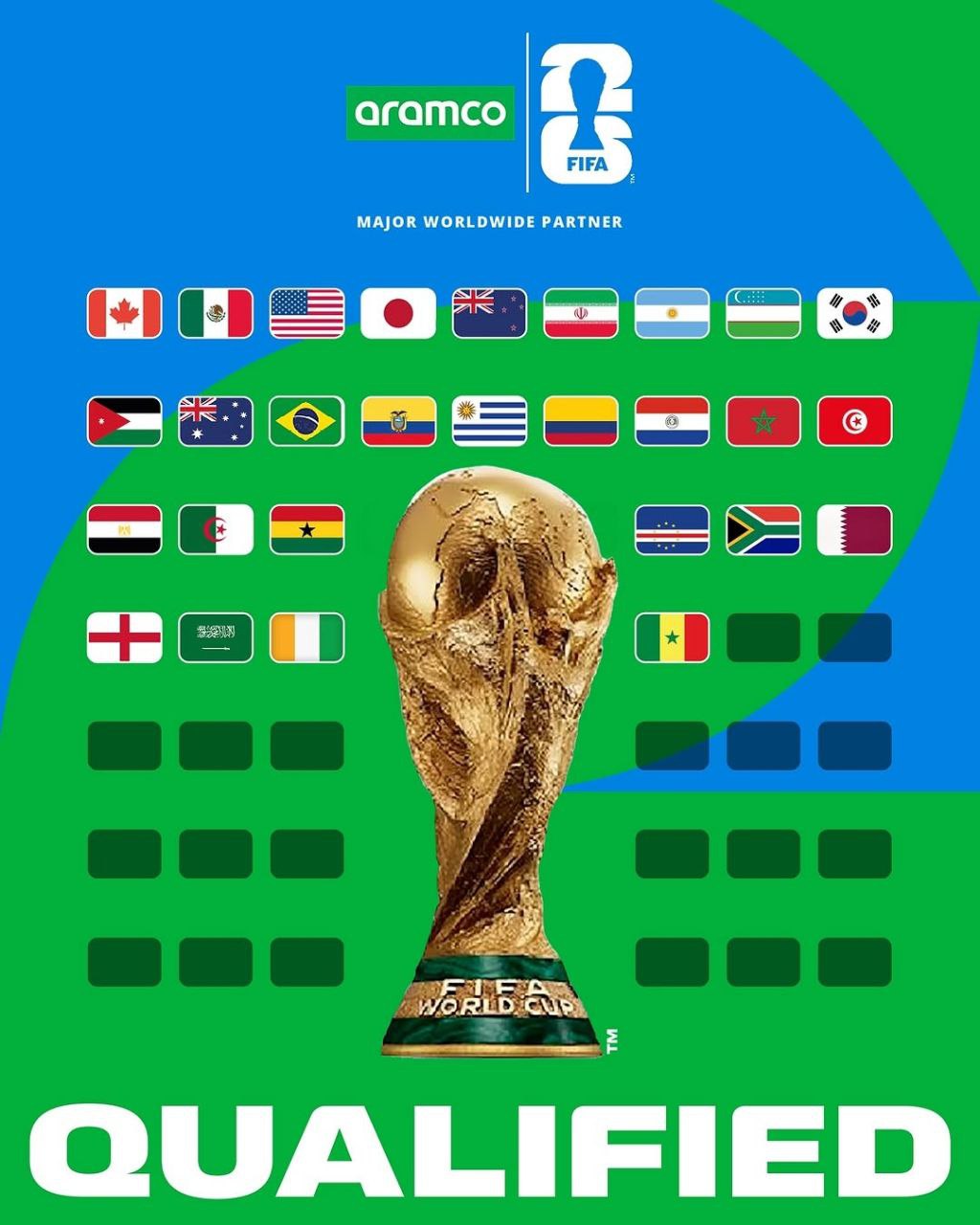
With just a little over seven months left until the finals, teams are gearing up as the November Qualifiers window begin. A total of 20 qualifications spots are still up for grabs this November and March as 28 nations have already qualified for the tournament. The competition will be hosted by the United States, Canada and Mexico and a further 14 teams will qualify for the tournament this month, while the remaining 4 spots will be filled by European teams in March. Six teams will then compete in the inter-confederation play-offs after which two teams will progress in a last chance to join the nations that qualified on direct qualification.

Qualification in each Confederation
UEFA: Europe has been favoured with the most slots as long as history shows with their numbers going from 11 to 16 as the tournament progressed from 32 to 48 teams. This may account for their restrictions as they are the only confederation which will not have a team at the inter-confederation playoffs.
In the qualification phase, the nations were divided into six groups of four, and six groups of five with each group winner gaining automatic qualifications – for now only England has secured a spot. The other 11 winners are yet to be decided but once that is done, the 12 runners-up will move to the second round of qualifications to be joined by the top four teams from 2024/25 Nations League group winners that finished outside the top two of their qualify group – based on their Nations League interim overall ranking (Wales, Romania, Sweden and Northern Ireland).
The 16 teams will then be split into four, each made up of single-leg semi-finals and a final which will hold on March 26 and 31 respectively. These match fixtures will be decided by seeding pots in line with FIFA rankings, with teams from pot one facing another from the next pot four, and those from pot two facing teams from pot three – the higher teams will play at home. The winners of the four finals will then head to the World Cup.
CAF: in the African setting, the teams were split into nine groups of six, with each group winner getting an automatic ticket to the World Cup. The group stage of the competition ended last month with nine teams – Algeria, Cape Verde, Ivory Coast, Egypt, Ghana, Morocco, Senegal, South Africa, and Tunisia, already securing a spot in the World Cup. One of four teams, Nigeria, Gabon, DR Congo, and Cameroon, will head to the Inter-confederation play-offs.
Just as in Europe, the teams will compete in a semi-finals and finals pattern. Nigeria will face Gabon, while Cameroon will face DR Congo today. The winners will then face off in the final on November 16.
AFC: Here, eight teams have qualified – Japan, Australia, Iran, South Korea, Saudi Arabia, Qatar, Uzbekistan and Jordan. The latter two will be playing at the tournament for the first time. The AFC’s qualifying system is rather complex with five rounds;
In the first round, teams ranked 27-46 were drawn into 10 home and away fixtures were the winners moved to the second round consisting of teams from the group of 1-26. The 36 teams were then split into nine groups of four. Each group winner and runner-up will then advance to the third round. 18 teams made the third round and were then divided into three groups of six, where the top two teams from each group made the World Cup.
In the fourth round, the third and fourth placed teams from the previous round were further divided into two groups where the winners qualified.
Finally, the fifth round which will hold this month will have two runners up from the fourth round face off for a chance at the inter-confederation play-offs.
CONCACAF: The US, Canada and Mexico all qualified as hosts. The first round of qualifications saw the four lowest ranked teams compete in a home and away tie where two winners joined the other 28 teams, excluding the hosts, in the second round.
In the second round, they were split into six groups of five and the top two in each group advanced into the third round, three groups of four in which the winners qualified.
In November’s fixtures, Suriname, Jamaica, and Honduras are poised to qualify automatically while the two best runners-up will compete in the inter-confederation play-offs.
OFC: The OFC got an automatic qualification slot for the first time. We Zealand qualified after three rounds of qualify. The final round consisted of a four-team mini tournament including two semi-finals and a final. New Caledonia will head over to the Inter-confederation playoffs after losing to New Zealand.
CONMEBOL: The CONMEBOL like the OFC has completed its qualifications process. It maintained the same structure from previous years with all 10 teams playing each other in a home and away tie in a round-Robin format. The top six teams – Argentina, Columbia, Uruguay, Brazil, Paraguay, and Ecuador, have all qualified while seventh placed Bolivia will represent South America in the play-offs in March.

The Inter-confederation play-offs
Four teams will join New Caledonia and Bolivia where they will be split into two groups of seeded and unseeded teams with separate pathways. The two highest FIFA-ranked sides will be seeded and head on to the final of each pathway, whereas, the unseeded teams will compete in a pair of single-legged semifinals in North America. Two winners will then face the two seeded sides, where winners from each matchup will secure the 46th and 48th spots in the World Cup come 2026. Although the exact dates and venues are yet to be confirmed, the Inter-confederation playoffs is set to hold in March, 2026.
#WorldCup2026